What Prana's lenders could have seen, and when
In May and June two banks went to court to foreclose on Prana Investments buildings in the Bronx. About seven months before Prana stopped paying, the holder of its old Signature Bank loans signed new agreements on 15 other Prana properties, with a city tax exemption attached.
In late May, ConnectOne Bank filed seven foreclosure actions against companies owned by Prana Investments, the San Francisco firm that owns 3,692 apartments in New York City. ConnectOne says it is owed $37.4 million. In June, Peapack Private Bank and Trust filed four more, over Bronx buildings at 3021 Holland Avenue, 1694-1698 Selwyn Avenue, 4188 Barnes Avenue and 689 East 187th Street. Peapack says Prana owes it more than $15.5 million and stopped making monthly payments around March (The Real Deal, July 7). Prana told The Real Deal it is negotiating with its lenders. Peapack declined to comment and ConnectOne did not respond.
Peapack and ConnectOne were holding performing loans through 2025. The question is what a lender watching Prana could have seen before the payments stopped in March. Most of it was in New York City's own records: a City Council vote and a batch of deeds and loan agreements in the summer of 2025, about seven months earlier, and violation counts at one of ConnectOne's buildings.
What happened
Prana buys older rent-stabilized apartment buildings, mostly in the Bronx and Upper Manhattan. It paid about $83 million for the buildings now in foreclosure, and bought all but one of them before New York's 2019 rent law sharply limited rent increases tied to renovations (The Real Deal, July 7).
Signature Bank was one of Prana's largest lenders. After Signature failed in 2023, its rent-stabilized loans went into a venture with the FDIC that is serviced by the nonprofit lender Community Preservation Corporation, or CPC (CPC, December 15, 2023). CPC's main tool, it has said, is modifying loans to restore cash flow (The Real Deal, July 2, 2025). ConnectOne consolidated its loans on 18 Prana tax lots in October 2024. Peapack's loans were older.
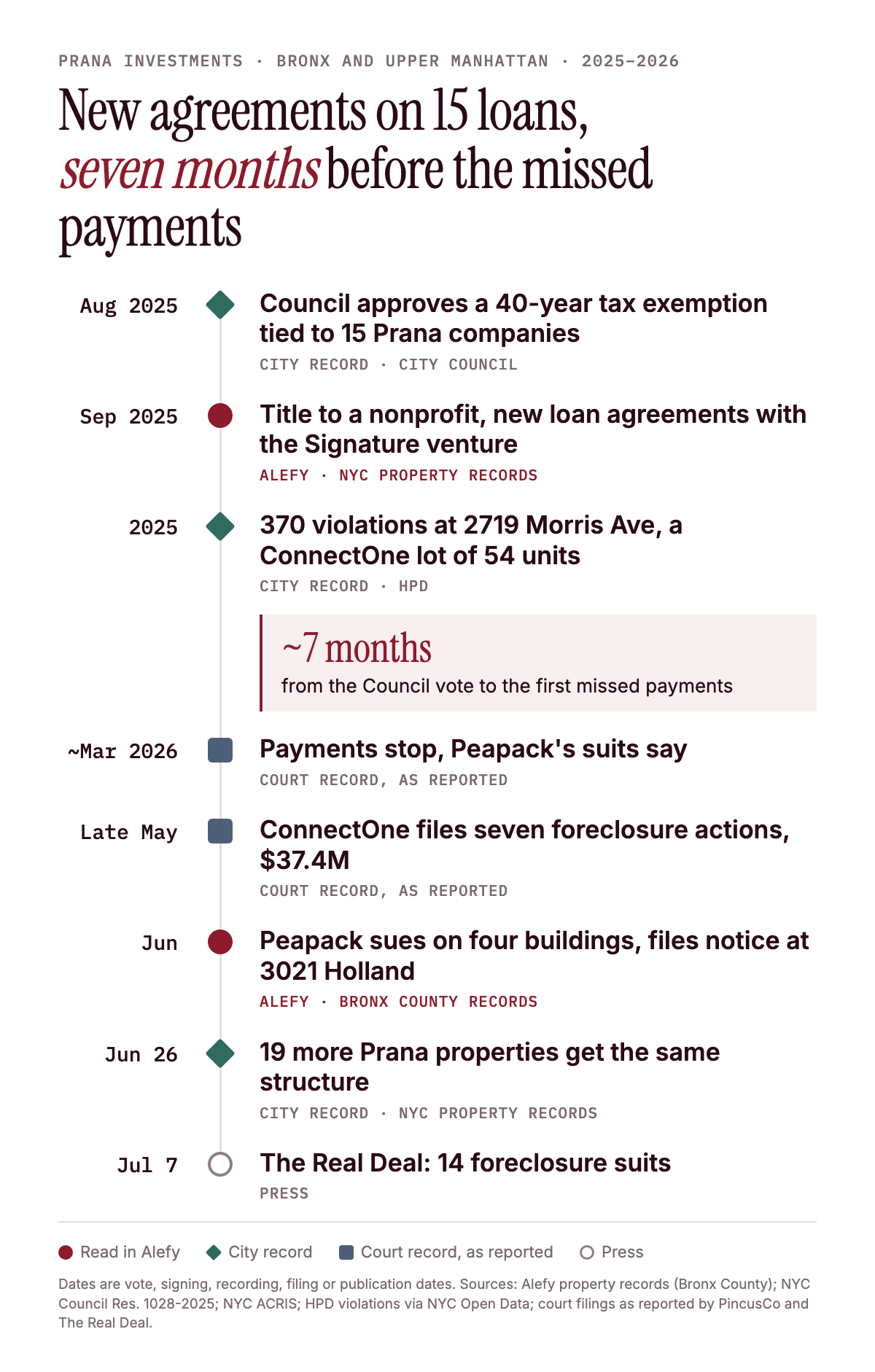
What was public, and when
2025: violations at a ConnectOne building. New York's housing agency, HPD, issues violations after inspections. At the two-building, 54-unit lot at 2719 Morris Avenue, part of ConnectOne's 2024 consolidation, it issued 370 in 2025, 160 of them class C, the category HPD treats as immediately hazardous. HPD later dismissed 112 of the 370, and its records list 14 false certifications of correction at the lot (NYC Open Data, HPD violations).
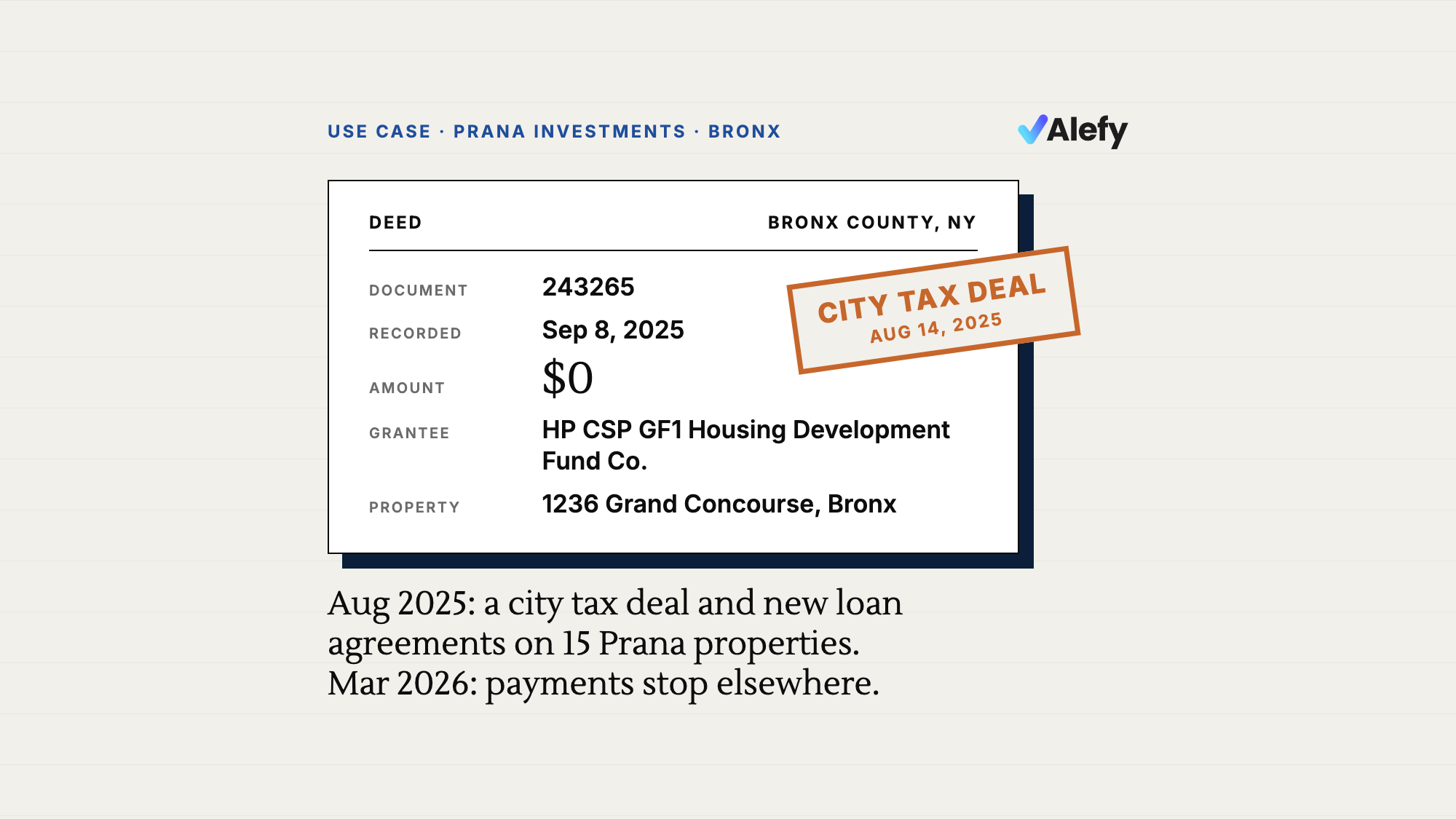
June to September 2025: new agreements on 15 Signature loans. On June 11, 2025, HPD asked the City Council to approve a property tax exemption for 17 tax lots held by 15 Prana companies. The Council approved it on August 14 (Resolution 1028-2025). For up to 40 years, the owners pay 5 percent of gross rents instead of property tax, under a regulatory agreement with HPD. As the program requires, legal title goes to a nonprofit housing development fund company, HP CSP GF1, and the Prana companies keep the economics: the resolution names them as owners alongside it. The deeds were signed on August 27 and recorded the week of September 8. By early October, new loan agreements between the Prana companies, the nonprofit and the Signature venture had been recorded too.
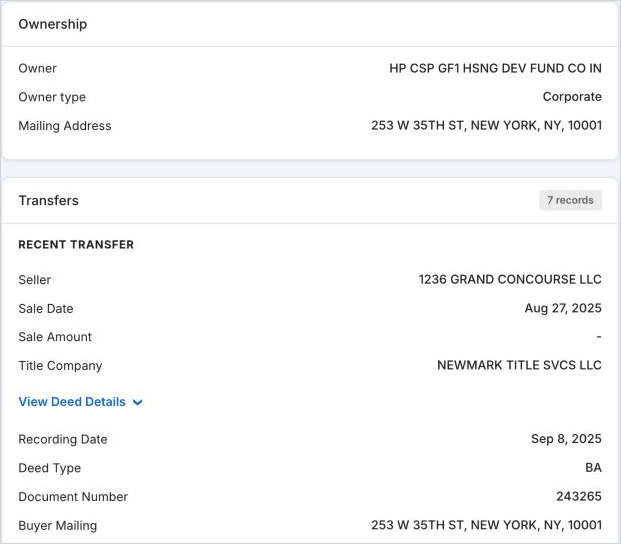
The August 27 deed in Alefy's record for 1236 Grand Concourse, one of the 15 properties. Title moved to the nonprofit for no price. A new loan agreement on the building was recorded on September 30.
The exemption lowers costs at those 15 properties. Our read is that a lender whose main tool is modification, signing new agreements on 15 of one borrower's loans at once, was restructuring that borrower. None of the 17 lots secure Peapack's or ConnectOne's loans.
Around March 2026: payments stop. Peapack's complaints say Prana began missing its monthly payments around March.
Late May: ConnectOne files. ConnectOne's foreclosure filings in Bronx County are dated from May 26, and PincusCo reported seven of them on June 1 (PincusCo). According to The Real Deal, one complaint cites 302 HPD violations at three Prana buildings and alleges gross mismanagement.
June: Peapack files. Peapack's notice of pendency on 3021 Holland Avenue is dated June 26.
June 26: 19 more properties. The same day, 19 more Prana companies signed deeds adding a second nonprofit, HP Third Street PR1, to the title of their buildings, with new agreements with the Signature venture and the city, recorded July 14. The Signature venture was still signing with Prana while two banks were in court.
Why the Signature loans got a different deal
According to The Real Deal, the Signature venture's agreement with the FDIC keeps it from simply selling troubled loans at a discount, so foreclosure is its last resort and modification its main tool. The city's tax programs are part of that toolkit. Peapack and ConnectOne hold conventional bank loans, and the tax relief covered only the buildings in the deal. Other lenders to the same borrower are not party to that negotiation.
What a lender holding Prana loans could have done
Treat a $0 deed to an HDFC as a trigger. A $0 deed to a housing development fund company, plus a new agreement with another lender on the same borrower, is a watchlist flag and a reason to call the guarantor.
Use the guaranty while the loan is current. Ask the guarantor for an updated schedule of real estate owned and contingent liabilities, and test it against the liquidity and net-worth covenants. A guarantor with a large share of its buildings in restructurings has less behind its signature than last year's statement shows.
Treat class C violations on your own collateral as a covenant issue. Most loan agreements require compliance with laws. Hundreds of open hazardous violations, or false certifications of repairs, are grounds to ask for a cure plan and an inspection before anything else changes.
Sources
- The Real Deal: Prana Investments' NYC multifamily portfolio faces 14 foreclosure lawsuits, July 7, 2026.
- PincusCo: ConnectOne files 7 pre-foreclosures totaling $37.4M at Prana Bronx rentals, June 1, 2026, and property pages for 2609 Bainbridge Avenue and 2523-2525 University Avenue.
- New York City Council: Resolution 1028-2025, adopted August 14, 2025.
- NYC Open Data: HPD Housing Maintenance Code Violations.
- Community Preservation Corporation: Closing with the FDIC on the Signature Bank rent-stabilized portfolio, December 15, 2023.
- The Real Deal: Inside a nonprofit's billion-dollar cleanup of rent-stabilized debt, July 2, 2025.
- NYC ACRIS: deed 2025090400556001 and agreement 2025092500349001 (1236 Grand Concourse); agreement 2024101100501009 (2718-2719 Morris Avenue, ConnectOne); June 26, 2026 agreement 2026071000391028 (1562-1580 Thieriot Avenue).
- Alefy property records: 1236 Grand Concourse, Bronx (APN 02457-0010), deed document 243265 (CRFN 2025000243265) of August 27, 2025; 3021 Holland Avenue, Bronx (APN 04569-0043), Peapack notice of pendency of June 26, 2026.